


Workshop Components FYTT II
Upcoming Workshop Components
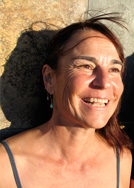
Bhagavad Gita, The Intersection of Body, Mind and Heart
with Carrie Adams
2 Workshops, 8 hours total
July 1 & 15
Sundays 2:30 - 6:30 p.m.
This workshop is open to all interested students.
Bhagavad Gita, the Song of the Blessed One, is an indispensable text for the practice of yoga. Its lyrical words have withstood the test of time and imparted wisdom and inspiration for centuries.
In this series we will enter the conversation of the text and engage with the dialogue of the Gita via a multi-faceted approach. My intention is not to study not from the viewpoint of lecture, but rather, through reading, reflection, writing and asana, to begin a collaborative conversation that stems from the text itself. One that deepens our understanding of how these eternal teachings apply to our everyday lives.
In order to facilitate our conversation, participation in both sessions is a requirement.
Required text:
Bhagavad Gita: a New Translation, by Stephen Mitchell. Three Rivers Press, 2000.
For Registered Yoga Teachers:
This class is approved for 3 Continuing Education Units for Yoga Alliance. If you would like to receive a certificate of completion, please mention it when you register.
To Register
Please enter the workshop that you are registering for and any other relevant information in the “Special Notes & Instructions” box that will come up during the payment process.
Cost:
Early Registration, register and pay by June 17, 2012:
$88
Regular Registration:
$104
Or, send a note including the workshop that you are registering for and any other relevant information, along with a check payable to Barefoot Movement to:
Barefoot Movement Headquarters
455 17th St. #333
Oakland, CA 94612
Anusara Universal Alignment Principles & Yoga Therapeutics
with Carrie Adams
September - December, 2012
Anusara Universal Alignment Principles (UAP)
6 Workshops, 21 hours total
September 8, 9, 22, 23; October 6, 7
Saturdays 3:00 - 6:00, Sundays 2:30 - 6:30
Yoga Therapeutics
5 Workshops, 20 hours total
October 21; November 4, 18; December 2, 16
Sundays 2:30 - 6:30
This workshop is open to yoga teachers and serious students.
Yoga therapy can be a remarkably effective means of physical therapy, one that has the potential to address a broad range of musculoskeletal injuries and limitations. A major component of successful yoga therapy is applying good alignment in a variety of postures or yogic exercises. Good alignment occurs when bones and connective tissue are positioned in such a way as to create maximum range of motion, with strength and stamina in an injured or healthy region. Furthermore, when our bodies are in good alignment there is optimal flow of blood, lymph, and prana, all of which naturally facilitate health and healing.
In this series we will look at therapeutics predominantly from the perspective of Anusara Yoga. The Anusara Universal Principles of Alignment will be covered and applied to a variety of injuries and common misalignments in different postures and yogic exercises in order to improve strength and mobility. By working with each other and with people with actual injuries or physical limitations you will learn how to attune with your students, how to gather information via questions and observation. Ultimately you will learn how to use the information to offer a student support, relief from pain, and increase their confidence in their own ability to listen to and heal their body. You will also learn specific yogic exercises for increasing strength and mobility in various regions of the body. Throughout the weeks you will sharpen your observational skills and perfect your ability to guide students into good alignment through verbal cues and hands-on adjustments.
This workshop series will build off the knowledge base created in Joan Marie’s Anatomy Series. In 10 sessions, 4 hours each, we will look at some of the most common yoga injuries and misalignments and explore how a yoga practice that is mindful of the Universal Principles of Alignment can not only help to prevent injuries, but also facilitate healing. The first half of the series will cover the Universal Principles of Alignment. We will use asana, observation, and basic adjustments in order to deepen our understanding of how the UPAs work and how they may be employed to bring ourselves and each other into optimal alignment. The last half of the series will work regionally, looking at specific injuries and misalignments and the corresponding corrections and concepts to apply. The first half of the session may be taken independently of the second half, and is a prerequisite for the second half. Participation in the Anatomy Series is not a prerequisite though it will be useful.
The text for the series is, Anatomy of Movement, by Blandine Calais-Germain.
For Registered Yoga Teachers:
This class is approved for Continuing Education Units for Yoga Alliance. If you would like to receive a certificate of completion, please mention it when you register.
Cost: (prices shown are Pay in Full prices, talk with Leah about a monthly payment plan)
Anusara UAP only:
$275 by June 8
$300 by Sept 8 (first day of class, if there is still space available)
Anusara UAP and Yoga Therapeutics (UAP is a Prerequisite for Therapeutics)
$500 by June 8
$550 by Sept 8 (first day of class, if there is still space available)
Or, send a note including the workshops that you are registering for and any other relevant information, along with a check payable to Barefoot Movement to:
Barefoot Movement Headquarters
455 17th St. #333
Oakland, CA 94612
Past Workshop Components
Anatomy for Posture and Movement
with Joan Marie Passalacqua
Registration Closed
January - May, 2012
10 Workshops, 40 Hours Total
Field Trip! This workshop series will take place at the Applied Anatomy Institute 2700 Eighth Street, Berkeley, CA 94710
During these classes, we’ll delve into the structural aspects of posture and movement. You’ll learn about how our muscles, bones, and fascia influence comfort, function, pain, and dysfunction during various activities. We’ll use yoga postures as practical examples for studying muscle action, joint function, and fascial effect throughout our bodies. The understanding you gain from these examples can easily be used to figure out some of the causes of joint and soft tissue pain in everyday activities.
You’ll get both an embodied and academic understanding of anatomy as you experience it in class while you’re learning about the details. We’ll explore the dynamics of tension and compression by manipulating a tensegrity* toys. You’ll feel how the bones, muscles and fascia influence movement and joint function. Home study assignments will encourage you to use what you’ve learned between classes.
*The word tensegrity comes from combining two words: tension and integrity. Tensegrity is used to identify a type of structural integrity that’s based on the interaction between tension and compression. In biological structures, such as our bodies, an example of tensegrity is the interplay between our compressive parts (bones) and our tensile parts (fascia, ligaments, tendons and muscles). Applying the concept of tensegrity to how we use and work with our bodies promotes the inherent flexibility and dynamic balance of our physical structure.
Classes will include: slide shows, lecture, handouts, demonstrations with a life-size skeleton, anatomical models, illustrative teaching aids, drawing on human subjects, experiential exercises, discussion, Q&A, and home study assignments.
Teaching aids will include: slide shows, lecture, handouts, demonstrations (including life-size skeleton, anatomical models, illustrative teaching aids, and drawing on human subjects), experiential exercises, discussion, Q&A, and home study assignments.
This workshop will create a solid foundation for the Therapeutics Series taught by Carrie Adams.
TEXT BOOKS: The Anatomy Coloring Book, 3rd Edition, Wynn Kapit and Lawrence M. Elson. Highly Recommended: Anatomy Trains, 2nd Edition, Thomas W. Myers; and The Architecture and Design of Man and Woman, Alexander Tsiaras.
 Asana and the Art of Adjustments
with Kristyn Marshman
September - December, 2011
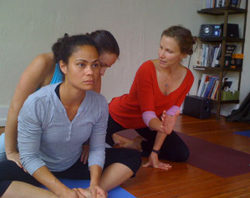
In Eight workshops, Kristyn will address how to see the two complimentary yet opposing patterns of prana and apana in the yoga poses. We will learn how to notice and address students with different holding patterns that include constrictions, weakness, and deadness in yoga poses. We will refine our touch and adjustments to help each other discover our way out of the holding patterns and into the aliveness in each asana. We learn how to approach all kinds of students: stiff, flexible, eager, defensive, passive, etc. Students will be practicing giving and receiving adjustments on each other.
with Cybèle Tomlinson
This workshop series is open only to full FYTT II participants.
Workshops are sprinkled throughout the FYTT II program. Saturday workshops are 3:00 - 6:00p.m., Sundays 2:30-6:30:
The word “yoga” means “to yoke” and can be translated as the union between mind, body, and heart. We can understand this as a state in which these aspects of ourselves are functioning harmoniously, without conflict, so that whatever life presents us can be fully “met” with all of our “self” responding in a fearlessly authentic and free way. What would it be like to have this capacity, all the time? What would it be like to be this free? We don’t really know until we’ve experienced it, but it is a freedom that humans interested in the spiritual life long for. This is the heart of yoga. This is what yoga promises us, and when we teach yoga, this is what we are orienting students toward.
Each of us is unique-with a unique body, life situation, history, conditioning, talents and abilities, etc; and each will have a unique journey on the yogic path. Yet there are certain markers along the way, pointed to by the yogic sages, to which we all have access. Some of these markers can be found in the texts of the yogic tradition. We can delve into these texts, taking the time to relate to them in a very personal way, to see what import they have for us, to see how they speak to us and what they mean to us.
This is what we’ll do in this portion of the teacher training: explore the Eight Limbs as outlined by Patanjali in the Yoga Sutras, with a particular emphasis on the Yamas and Niyamas and Pranayama. We’ll also read and discuss portions of the incomparable Upanishads. We’ll use inquiry, working in groups of two or three, to discover our own meaning in relation to these texts, as well as our questions, and to see where we may feel blocked and unclear. Writing will be another tool employed in our process of exploration. Pranayama will be included in each of our meetings and will be a required part of our practice between meetings; and we will go over principles for understanding and then teaching breath awareness to others. In particular, we’ll practice and discuss: ujjayi breath, breath as it relates to asana, the function of inhale vs. exhale, and various pranayama techniques such as nadi shodhana, kapalabhati, viloma krama, and others. Participants will receive handouts for future reference.
It is important to recognize that the yogic path is one of no arrival, of continual unfolding mystery. So even as we understand and know more, both of ourselves and of yoga, there is always more to discover, more to understand, more to inquire into. As teachers, this is the most important teaching we can impart to any student, through our living example.
Required texts for this series: The Upanishads, translated by: Eknath Easwaran
and The Heart of Yoga by: T.K. V. Desikachar